
Find Tennis Courts With Lights Nearby Fast
April 25, 2026
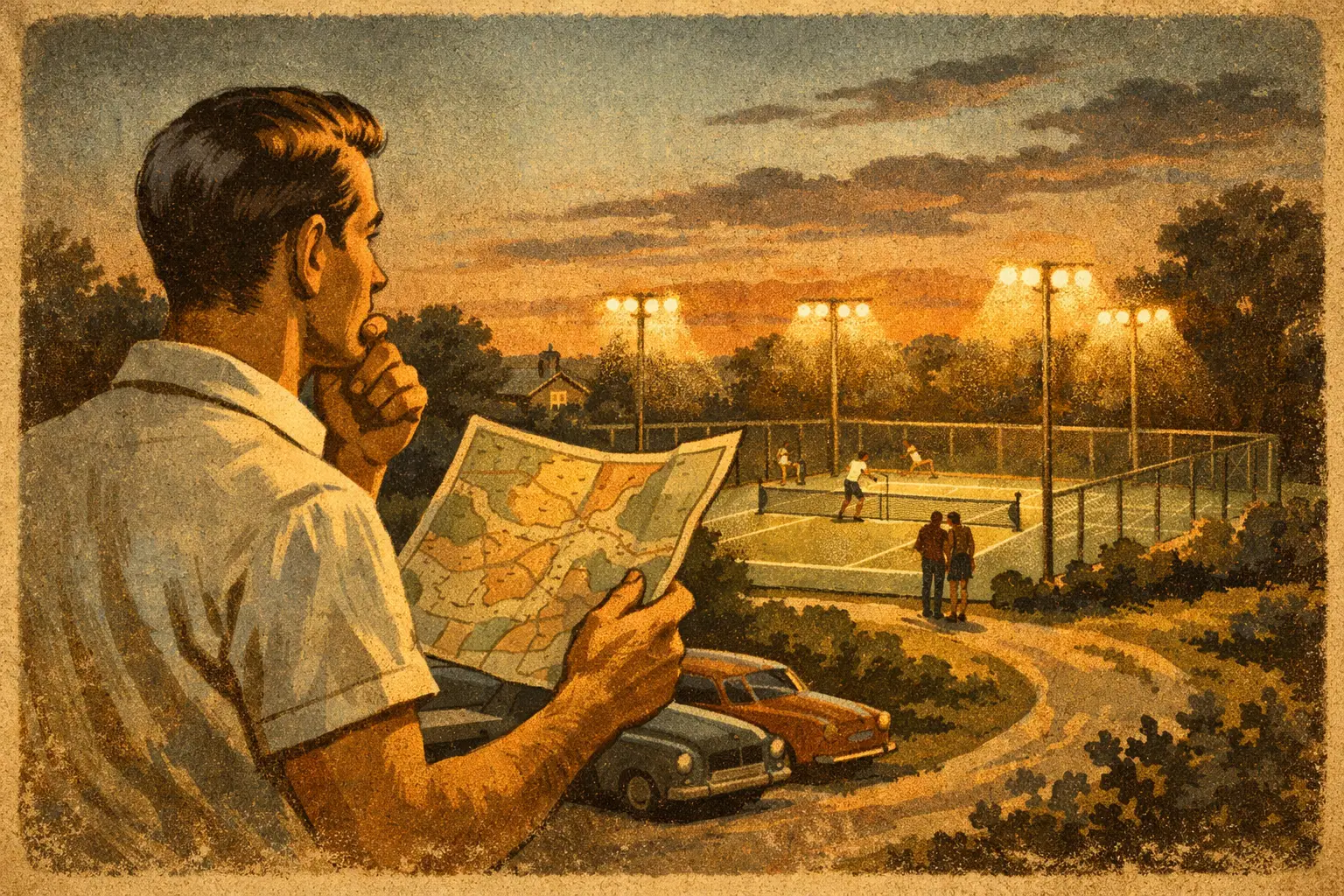
The hard part usually is not wanting to play. It is 7:15 p.m., work or class ran long, the sun is dropping, and now you need to find tennis courts with lights nearby that are actually usable, open, and worth the trip. That search gets annoying fast when half the courts online are outdated, locked, or too dim to rally on.
Night tennis solves a real scheduling problem, especially if you are trying to fit matches around a packed week. But lit courts are not all equal. Some are bright enough for serves and overheads. Others technically have lights, but you are basically tracking the ball by guesswork. If you want a better shot at getting on court instead of wasting time in parking lots, your search needs to be a little more strategic.
How to find tennis courts with lights nearby
Start with the most obvious filter first: search specifically for lighted tennis courts, not just tennis courts. That sounds basic, but broad searches often surface clubs, school courts, and park listings that never mention lighting clearly. If a venue profile includes hours, photos at dusk, player reviews, or event history, that is usually a stronger signal than a bare address.
The second move is checking for proof, not claims. A lot of court directories pull old public data, and lighting is one of the details most likely to be wrong. Parks get upgrades. Bulbs go out. Access rules change. If the only mention of lights comes from a generic description with no recent review, treat it as unverified until you see something newer.
This is where community data matters more than static listings. A venue is useful, but a venue plus recent player activity is what actually helps you play. If people are organizing evening sessions, checking in after dark, or talking about court conditions, you get a much clearer read on whether that location works for your schedule.
What to check before you drive over
Lighting is not just yes or no. The quality of the lights affects whether a court is good for casual hitting, serious singles, or not much at all. If you are trying to get reps in after work, there are four details worth checking.
First, look at operating hours. Some public parks keep the lights on until 9 p.m. sharp. Others run later, but only on certain days. A court that appears open can still go dark mid-set if you miss the cutoff.
Second, check whether the lights are automatic, timer-based, or staff-controlled. Timer systems are common at public facilities, and they can be great if you know how they work. They can also end your session early if you arrive without enough time left on the cycle.
Third, look for comments on brightness and court visibility. Competitive players notice this immediately. Dim baseline corners, uneven shadows, and lights aimed poorly across the court make a bigger difference than most venue descriptions admit.
Fourth, confirm access. Some of the best-looking lit courts are attached to schools, apartment complexes, or private clubs. They may show up in search results, but that does not mean you can walk on. Public access, reservation rules, and fees matter just as much as the lights themselves.
The best places to search for lit courts
If you want quick results, start with park and recreation listings, tennis facility directories, and sports community apps where people are actively coordinating games. Each source gives you something different.
City and county parks pages are often the best source for official hours and public access rules. The downside is that they are not always built for real-time accuracy. You may get the basics, but not current conditions.
Traditional court directories can help you map your options fast, especially in larger metro areas. Their weakness is freshness. A listing might still be live even if the nets are torn up or the lights have not worked in months.
Player-driven platforms tend to give you the details that matter once you move beyond browsing. Is the court busy at 8 p.m.? Are there pickup games? Can you challenge someone nearby instead of dragging a friend into a dozen texts? That is where a sports network starts to feel less like a map and more like a way to actually get a match going. For players who want to find a court and a game in the same move, that distinction matters.
Why evening court searches fail so often
A lot of players assume the nearest lit court is the best option. Usually it is just the easiest one to find. The problem is that night play adds friction in ways daytime tennis does not.
Public lit courts attract everyone who had the same idea after work. That means waiting, sharing, or getting bumped by players who know the local rhythm better than you do. If you are in a city, demand can spike hard from 6 to 9 p.m. If you are in a suburb, the issue may be fewer total options and longer drives between them.
Weather also hits differently at night. Wind feels bigger. Moisture builds up faster. In some regions, courts that look playable at sunset get slick an hour later. So if your goal is consistency, one verified night court near home and one backup near work is usually smarter than chasing the theoretically best facility across town.
How to tell if a lit court is worth using
Photos help, but context helps more. A great night court usually has even lighting, a decent fence line, visible court markings, and enough surrounding space that you are not serving into darkness beyond the baseline. If reviews mention league play, regular evening doubles, or organized sessions, that is often a strong sign the court performs well under lights.
Surface condition matters even more at night because bad patches are harder to read. Cracks, low spots, and worn lines become a bigger problem once visibility drops. If you play competitively, you may also want to avoid courts where nearby baseball fields or parking lot lights create glare.
There is also a practical trade-off between convenience and quality. A perfectly lit court 25 minutes away may be less useful than a decent local court you can reach three times a week. If you are building a playing habit, repeatability beats the one-off ideal setup.
Turning a court search into actual play
Finding the venue is only half the job. The real goal is getting on court consistently with people who match your level and your schedule. That is why the best sports tools do more than show pins on a map.
If you can create a game, invite local players, or throw out a direct challenge the moment you spot an open evening court, you remove the drop-off point where most plans die. One person says they are interested, another is maybe free after 8, and suddenly nobody plays. A stronger flow is simple: find the court, post the session, lock in who is coming, and let the group build around actual availability.
That is the bigger opportunity with community-driven sports platforms like Crewters. The win is not just helping you find tennis courts with lights nearby. It is helping you turn that late-night search into a real session, with players, structure, and a reason to come back. When people can join pickup games, issue challenges, track progress, and build local momentum around a venue, the court becomes part of a playing routine instead of a random one-off.
A smarter way to search when you are traveling
Travel makes the problem sharper. You do not know the neighborhood, local access rules, or which courts are worth your time. In that case, your best signal is recent activity from actual players. A quiet listing tells you there is a court. An active venue tells you there is tennis there.
Look for places with current reviews, posted sessions, or evidence of organized play. If you are only in town for a few days, the goal is not exhaustive research. It is reducing uncertainty fast enough to get a hit in without wasting your evening.
Find tennis courts with lights nearby and keep them in rotation
Once you find a good lit court, save more than the address. Keep notes on parking, busiest hours, timer quirks, court quality, and whether it is better for singles or doubles. That sounds small, but it turns a random search into a usable network of go-to spots.
The players who get the most court time are usually not doing anything fancy. They just build a short list of reliable places, know when those places work, and make it easy to rally their people. If you treat every search like starting from zero, night tennis keeps feeling harder than it should.
A good evening court gives you more than extra playing time. It gives your week another opening to compete, train, or just get out and hit. Find one solid option, get one game on the calendar, and let that be the start of your local tennis crew.