
What a Sports Community App Should Actually Do
September 26, 2026 · Chris Palmer
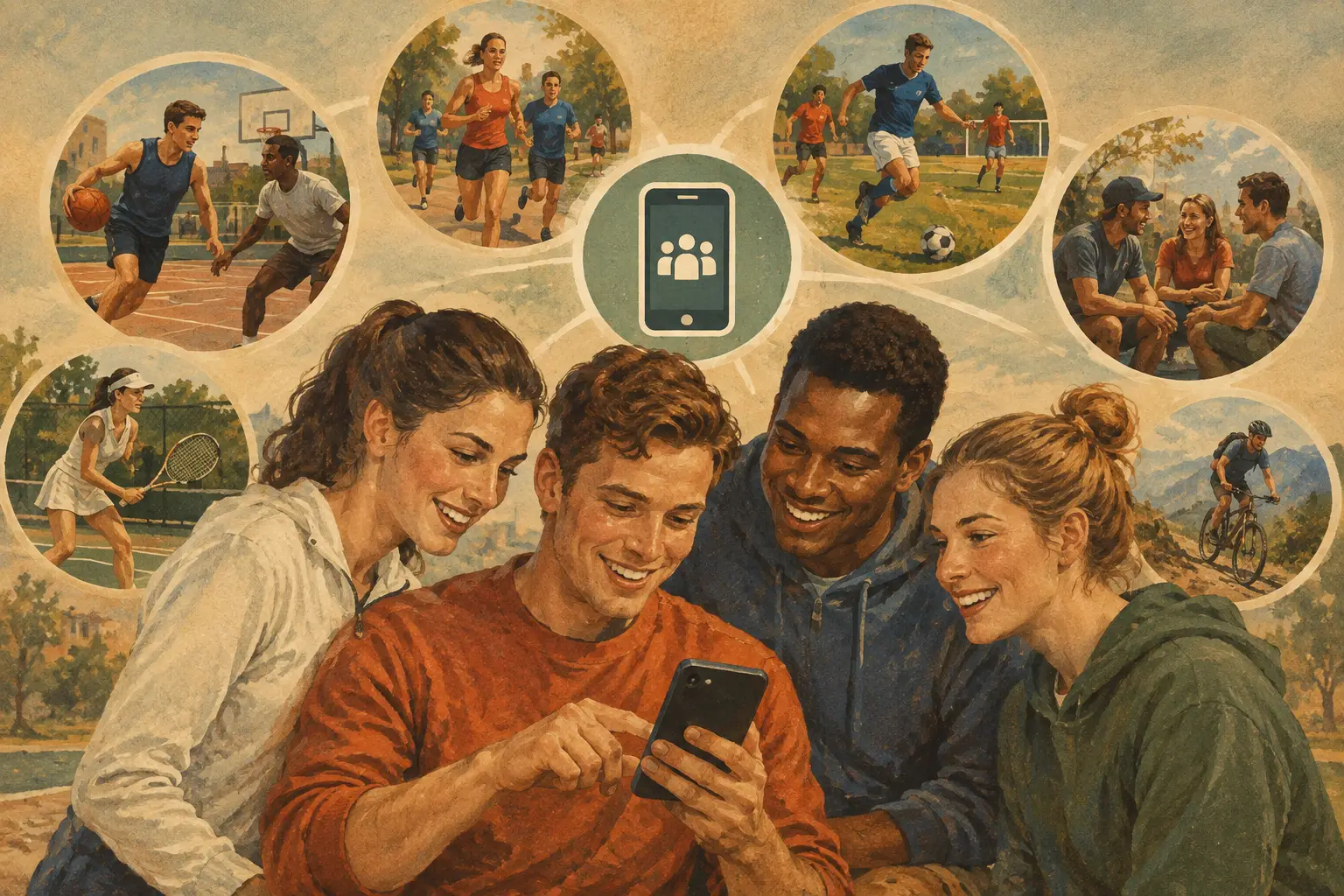
A spare Tuesday evening should not end with you scrolling through old group chats, sending five messages and still wondering whether anyone is up for a game. A good sports community app turns that moment into action: a nearby venue, a few available players and a plan worth leaving the house for.
That sounds simple, but most sports apps stop halfway. They might help you book a court, count your steps or follow elite fixtures. Useful, yes. But local sport happens when people can find each other, commit to a time and feel like coming back next week.
The difference matters for everyone from the player new to five-a-side in Manchester to the tennis regular travelling for work, the student trying a new sport, and the organiser who is tired of chasing late drop-outs. The best community apps do more than fill empty slots. They create a reason to belong.
A sports community app needs to start with real play
Sport is social infrastructure. You may have the motivation, kit and ability, but none of those guarantees a game. The usual barriers are painfully practical: you do not know where to play, you do not know who is available, or joining an established group feels awkward.
That is why venue discovery is more than a map feature. Players need to see the places around them where their sport actually happens, whether that is a leisure centre badminton court, a public basketball hoop, a climbing wall or a local padel venue. When you are away for the weekend or settling into a new area, that visibility becomes even more valuable.
Then comes the human part. An event should be easy to create and even easier to understand. What sport is it? What level is welcome? How much does it cost, if anything? Where and when does it begin? How many players are needed? Clear answers remove the social friction that keeps people at home.
For organisers, the goal is not to turn a casual kickabout into admin work. It is to make repeat play less fragile. A familiar group can still use a sports community app to find one extra player, open a session to newcomers or move a game when the usual pitch is unavailable.
The features that turn an app into a community
A directory and a calendar are a starting point, not a community. The real test is whether players build momentum after the first session.
Events should welcome both regulars and newcomers
Pickup events are one of the easiest ways into local sport because they lower the commitment threshold. You do not need to know a captain, buy a season ticket or promise every Thursday for three months. You just need to show up.
But openness needs context. A beginner-friendly volleyball session and a competitive 7-a-side match can both be great events, provided people know what they are joining. Good event tools give organisers room to set expectations without making the process heavy.
They should also make attendance visible. Seeing that eight people have joined a session makes it feel real. It creates accountability too: when your name is on the list, bailing at the last minute is less likely to feel consequence-free.
Challenges give competition a home
Not every game needs a league table. Sometimes the right prompt is simply: fancy a rematch?
Direct challenges let friends, rivals and local players turn friendly talk into an actual fixture. They work especially well for one-to-one and small-team sports such as tennis, squash, basketball or football, but the idea travels across sports. Challenge another crew, agree the rules and settle it on court, pitch, track or wherever your sport lives.
There is a trade-off here. Competition can motivate people, but it can also put off newcomers if every interaction feels like a trial. The strongest sports communities leave room for both: relaxed social play for people finding their feet, and proper competitive energy for those chasing the next win.
Teams and leagues make routine stick
A team turns participation into a shared responsibility. When people know their teammates, they are more likely to turn up, communicate and improve. That is the part no booking confirmation can replicate.
Leagues add a longer horizon. A one-off game is fun; a season gives players a story to follow. Results matter more, rivalries develop, and even the difficult weeks feel worthwhile because there is another match ahead.
This does not mean every player wants a formal league. Some only want occasional social games. A useful app lets people move between both modes instead of forcing them to choose an identity on day one. Join a casual event this week, form a team next month, enter a league when your crew is ready.
Progress should reward participation, not just talent
Local sport has a retention problem that rarely comes down to ability. People stop because their routine breaks, they do not feel noticed, or they cannot see the progress they are making.
Stats, goals, trophies and achievements can help when they are tied to genuine participation. A player who attends four sessions in a month, tries a second sport or completes a personal goal has done something worth recognising. That recognition is not childish. It is a nudge to protect time for the things that make life better.
The key is balance. Numbers can add energy to sport, but they should not turn every casual game into an audition. A rating after a match can be useful when it encourages reliability, good sportsmanship and fair play. It becomes less useful when it rewards ego or creates cliques.
The same applies to live streaming and rewards. Sharing a match can make a local event feel bigger and give players a record of their effort. Consent, safety and a clear understanding of who can watch must come first, particularly where younger players are involved. Features should strengthen trust, not trade it away for attention.
One network beats a pile of disconnected apps
Most people do not live inside one sport forever. Someone might play football with colleagues, take up tennis in summer, try a running club, then get hooked on basketball after a friend invites them. Yet local sports technology is often fragmented, with each activity pushed into a separate app, chat or website.
An all-sports community creates useful crossover. Players can bring friends from one activity to another. Venues can reach more relevant people. A newcomer does not need to learn a different system every time curiosity strikes.
That does not mean every sport should be treated identically. A cycling group has different needs from a five-a-side team, and a martial arts session has different safety expectations from an open basketball run. The shared network should make discovery and connection easier while respecting the culture of each sport.
Crewters is building around that idea, bringing venue discovery, events, challenges, teams, leagues and progression into one place across 122 sports. The bigger point is not the feature count. It is giving people a connected route from “I want to play” to “I have found my crew.”
The best communities are built with their players
Sports apps often fail because they are designed as finished products and handed down to the people expected to use them. Local sport is too varied for that approach. Players know where the gaps are: the venue that is missing from the map, the sport that needs better filters, the organiser who needs a simpler way to manage a weekly session.
Building in public changes the relationship. Early users are not just downloading another tool. They are testing it, challenging weak ideas and voting on what deserves to be built next. For sports-tech fans and developers, that can mean contributing directly to an open-source project. For everyday players, it means their frustrations can become product priorities instead of disappearing into a generic support form.
This approach takes patience. Community feedback can be messy, and not every requested feature belongs on the roadmap. But listening closely is how an app earns the right to call itself a community product.
The next great local game may not need a complicated plan. It may only need one player to post it, a few others to join, and a place where turning up feels easier than sitting out. Find your crew, make the invite and help shape what local sport becomes next.