
How to Find Pickup Basketball Games Near Me
April 17, 2026 · Chris Palmer
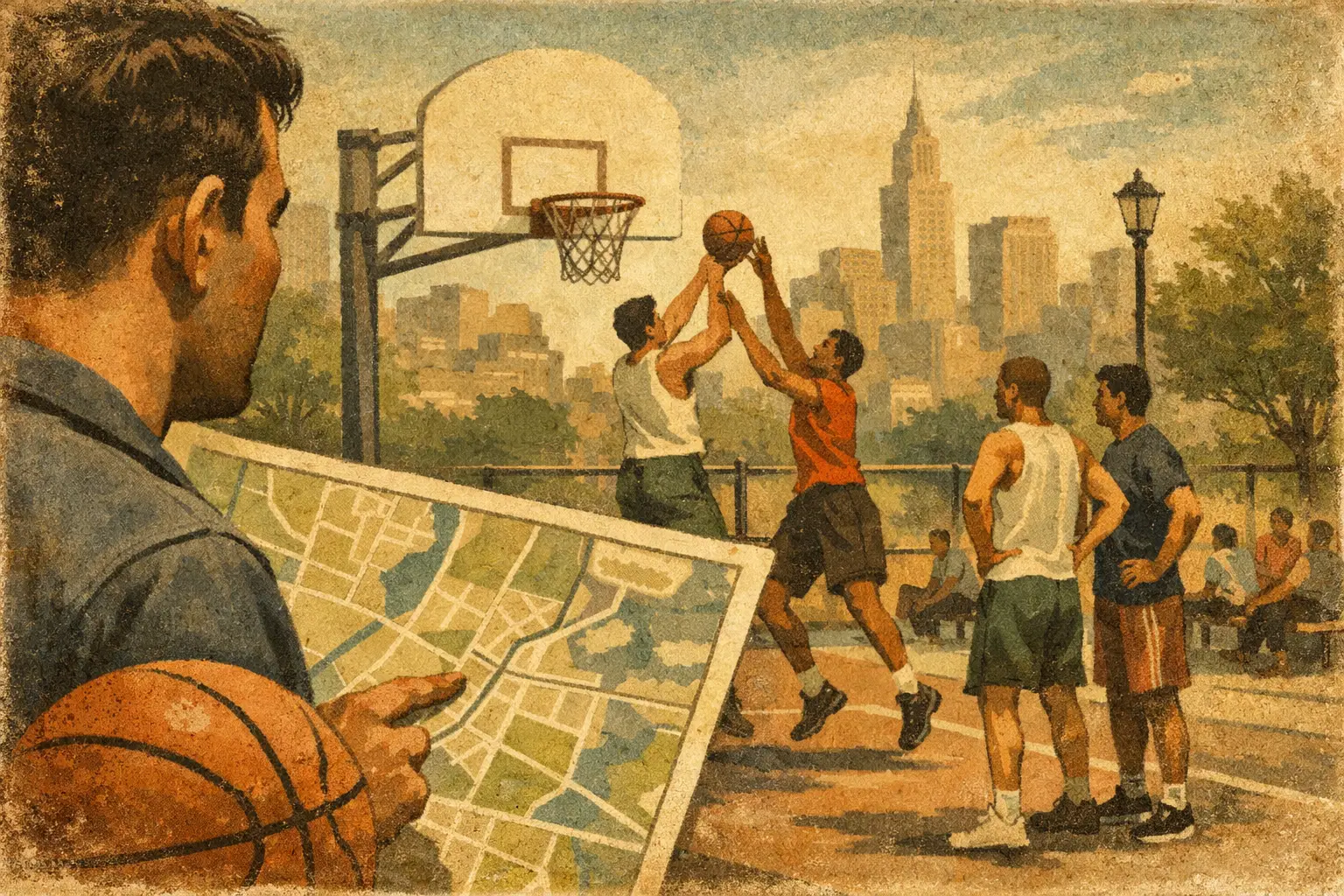
You don’t need another night of texting five friends, checking three group chats, and still ending up at a half-empty court. If you want to find pickup basketball games near me, the real challenge usually is not basketball. It’s coordination. Good runs exist in almost every city. The hard part is knowing where people actually play, when they show up, and how to get into the rotation without wasting your evening.
That’s why the best approach is not just “search and hope.” It’s building a repeatable system. If you know how to read a local court, use the right digital tools, and show up in a way that gets you invited back, it gets much easier to turn “I want to hoop” into “I’ve got a game tonight.”
Where to find pickup basketball games near me
The fastest way to find real runs is to think in layers. Public courts are the obvious starting point, but they’re only one part of the local basketball network. Serious pickup scenes usually form across outdoor parks, rec centers, LA Fitness-style gyms, YMCAs, colleges, apartment complexes, and community sports apps.
Outdoor courts are usually the easiest entry point. They’re visible, low-pressure, and often open to anyone who shows up. The trade-off is reliability. A park might be packed on Sunday afternoon and dead on Wednesday night. Weather matters. Lighting matters. So does neighborhood rhythm. A court near a college campus plays differently than a court in a residential park.
Indoor gyms tend to be more consistent. If a rec center has open gym from 6 to 9 p.m. every Tuesday and Thursday, that’s a better signal than a random park run. The downside is access. Some gyms require memberships, day passes, or local residency. Still, if you care about regular runs, indoor access usually saves time.
Digital communities matter just as much as physical courts now. Local basketball groups, sports apps, and event-based networks help you spot games before you leave home. That changes everything. Instead of hoping ten players are already there, you can join a posted run, see who’s in, and get a better feel for the level before you show up.
Start with courts, but learn the pattern
A lot of players make the same mistake. They visit one court once, see nobody there, and assume the spot is dead. That’s not how pickup works. Courts have schedules even when nobody posts them.
The better move is to scout a few locations across different time windows. Try weekday evenings, Saturday mornings, and Sunday afternoons. Look for the courts where people are waiting on the sideline, not just shooting around. A full court with winners staying on says one thing. Three guys doing spot-up shooting says something else.
You also want to notice the social structure. Is the run open, or is it basically a private friend group using a public court? Some games are easy to join if you simply ask, “You all got next?” Others are technically public but closed in practice. That doesn’t mean you should force it. It means you should keep moving and find a run that actually wants more players.
Consistency beats randomness here. If a court has solid turnout twice a week, that’s your anchor spot. Build from there.
Use apps that show who’s actually playing
If you’re trying to find pickup basketball games near me without burning time, apps are the smartest filter. But not all sports apps work the same way. Some are basically static directories. Others help you coordinate actual play.
What matters most is whether you can see activity, not just locations. A court pin on a map is useful, but a scheduled game with joined players is better. Features like event creation, player challenges, team formation, ratings, and basic stats make a real difference because they create accountability. Players are more likely to show up when the game feels organized, even if it’s still casual.
That’s part of why platforms like Crewters are interesting for pickup players. Instead of treating sports as a generic listing problem, the focus is on building the full loop around play - discover a venue, join a run, challenge players, track progress, and become part of a local crew. That matters if you don’t just want one game tonight. It matters if you want a repeatable way to play more often.
The key is to choose tools that reduce uncertainty. If an app helps you answer who’s playing, where, when, and at what level, it’s doing the job.
Ask the right questions when you find a run
Once you spot a potential game, don’t overcomplicate the approach. Most pickup players are fine with newcomers if you’re direct and respectful. The best questions are practical.
Ask what time the run usually starts getting good. Ask whether they run full court or half court. Ask whether there’s an indoor backup if weather turns. Ask whether the same group plays other days. Those answers tell you more than a one-time invitation ever will.
You’re not just trying to get into one game. You’re trying to map the ecosystem. One court often leads to another. One regular might tell you where the stronger Sunday run is, which rec center has open gym, or which local organizer posts games consistently.
That’s how local basketball scenes actually work. They’re networks.
How to tell if a game matches your level
Not every run is for every player, and that’s fine. The goal is not to force your way into the toughest game in town. The goal is to find a level that keeps you coming back.
Watch two possessions before you call next. Are players defending hard or barely rotating? Is it physical, or mostly laid back? Are people moving the ball, or is every possession isolation and chaos? A game can be talented and still be a bad fit if the vibe is off.
There’s also a difference between competitive and toxic. Competitive runs are intense, but they still function. Toxic runs turn into constant arguing, hard fouls, and weird politics over who has next. If every possession comes with drama, that run is costing you more than it’s giving you.
For newer players, lower-pressure games are often better for building confidence and consistency. For experienced players, stronger runs can sharpen decision-making and conditioning. It depends what you want out of pickup. Fitness, reps, competition, and community are not always found in the exact same gym at the exact same time.
Show up in a way that gets you invited back
Pickup etiquette matters more than people admit. If you’re reliable, ready to play, and easy to run with, people remember that.
Get there on time, or early if it’s a crowded run. Bring the basics - shoes, water, a light and dark shirt if teams split that way. Call fouls fairly. Don’t dominate the ball if you just joined the game. Sprint back on defense. If you lose, stay engaged instead of disappearing to your phone.
This sounds simple because it is. But these habits separate players who get folded into the local scene from players who always feel like outsiders.
If you want even more consistency, stop thinking like a guest and start thinking like a builder. Create the run if nobody else has. Post the time, set the court, invite players, and make it easier for others to commit. Communities grow around whoever reduces friction.
Traveling? Use the same system in any city
One of the best tests of your process is whether it works away from home. If you’re visiting another city, the same rules apply. Start with known courts and gyms, then use active communities to verify where people are actually running games that week.
Travel adds a few extra variables. Some courts are famous but crowded. Some hotel-area gyms are convenient but weak. Some college-adjacent runs are great but seasonal. Again, it helps to use platforms that are built for sports participation rather than passive searching.
The upside is huge. Once you know how to find the signal fast, pickup becomes portable. Your game doesn’t need to stop because you crossed state lines.
The best way to play more is to make it easier for everyone
Most people searching “find pickup basketball games near me” are not asking for information. They’re asking for momentum. They want fewer dead ends, fewer no-shows, and more actual basketball.
The answer is part scouting, part social awareness, and part better infrastructure. Find a few reliable courts. Use tools that show real activity. Learn the runs, the times, and the people. Then contribute. Join games, create games, rate the experience honestly, and help shape the local scene you want to be part of.
That’s how pickup gets better - not by waiting for perfect conditions, but by building a better way to show up.